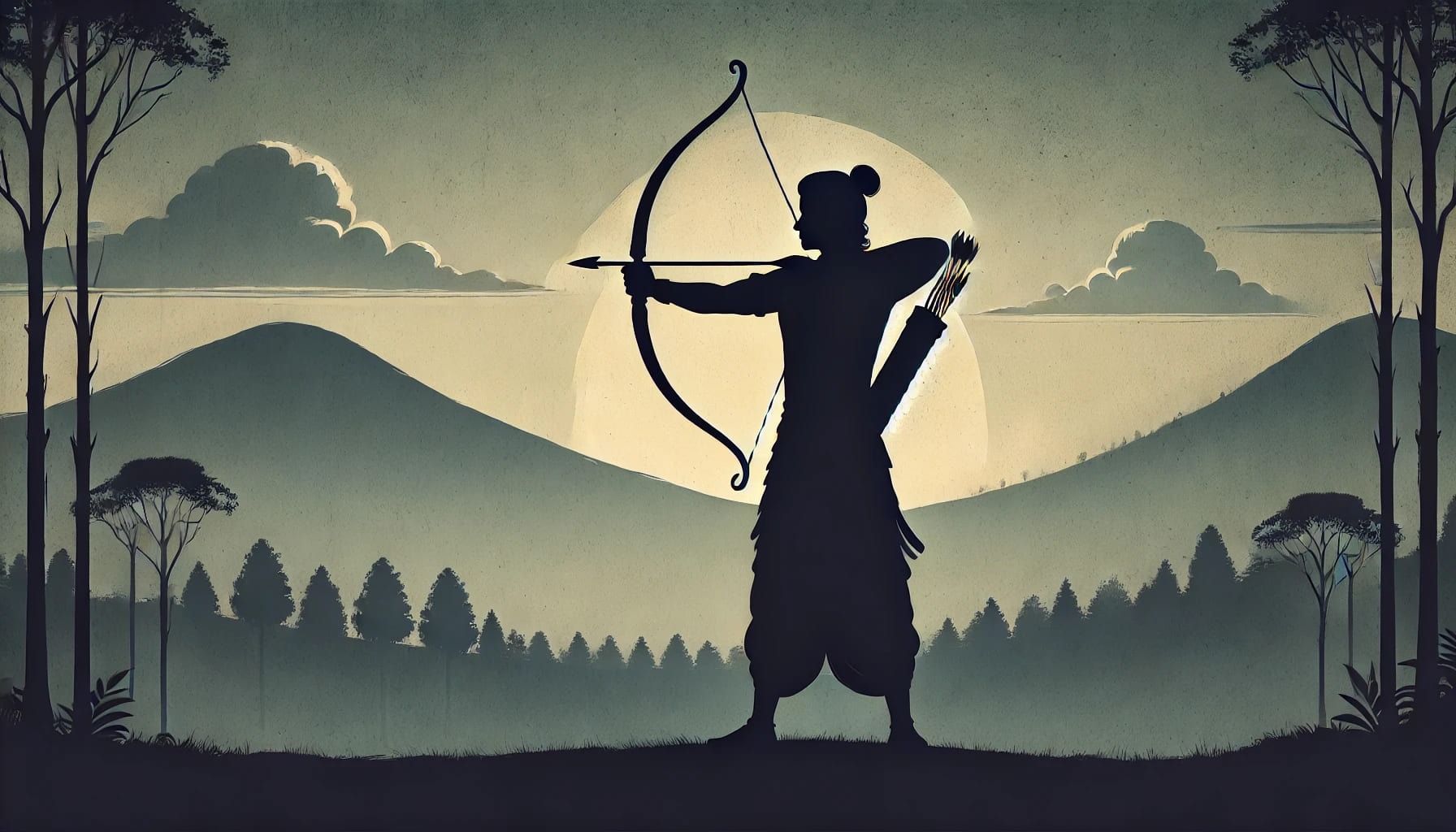
Arjuna did not like that a hunter boy was able to achieve levels of mastery in dhanurveda that he himself couldn't. It irked Arjuna that in spite of his master Drona's promise to make him the greatest archer in the world and in spite of his hardwork and in spite of all the support system he had, he was unable to do what this hunter boy could. He drags his master Drona to where the boy was practising archery. Drona ruthlessly asks for the boy's thumb as his guru dakshina (payment for the teacher), and the boy gives it without complaint. Ekalavya, the one-thumbed-one, was destroyed - and there would never be a worthy rival to Arjuna.
It makes one feel like the path to glory that Arjuna took was strewn with the remains of his unchivalrously defeated rivals. It makes one also wonder if Drona himself walked the path of Dharma he taught the princes so ardently. It also points an accusatory finger at everyone considering Drona an ideal preceptor when he so clearly showed deep bias towards one hand-picked student.
Another school of thought talks about how Ekalavya, son of Hiranyadhanusha, was a direct threat to Krishna and by extension to the Pandavas; and even as a grave injustice is committed to the talented boy, it is rationalised that it was in service of the fulfilment of a higher purpose. Neither Drona nor Arjuna knew of this connection (at least there is no mention of it in the Mahabharata); so any and all justifications are at best applied retroactively with an “ends-justify-means” logic, even if the actors were unaware of how it would eventually play out.
Whichever perspective one adopts, it is difficult to come to terms with how blatant the execution of the plan was and how completely Ekalavya is forgotten soon after the incident. It is also apparent that Nishadas were treated as less than equal; often their suffering is mentioned in a cavalier manner.
Drona’s vow and Arjuna’s unbridled ambition fueled by envy destroyed a young boy’s chance at greatness in a field where he showed a lot of promise – that much is undeniable.
The trick question that all children learn early on, about how you can draw a bigger line next to another existing line to make it shorter (without erasing the existing line), is a lesson well worth keeping in mind. We can fly higher than others by becoming better ourselves, rather than clipping a rival’s wings.
The question of achieving greatness has an answer that is simple in theory yet complex in execution: Focus and Perseverance – that’s the way.